

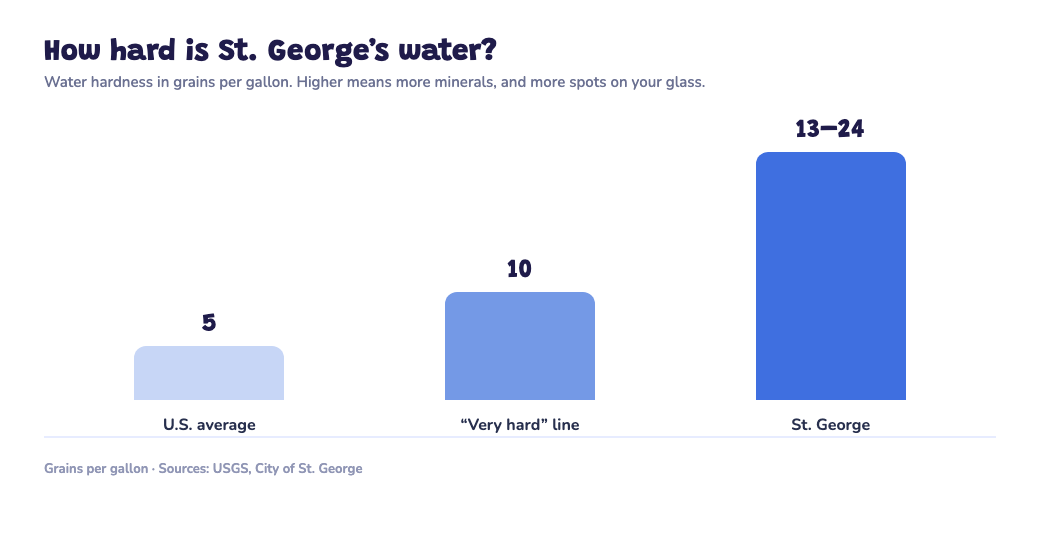
You cleaned the windows on Saturday, the sprinklers ran overnight, and by Sunday morning the glass is covered in chalky spots again. If that sounds familiar, you are not doing anything wrong. Those spots are hard-water minerals, and in St. George the water is about as hard as it gets. Here is what is actually happening, how to remove the spots, and when professional window washing in St. George is worth it.
What causes hard water spots on windows?
Our water carries a heavy load of dissolved minerals, mostly calcium and magnesium. When a drop of that water lands on glass and dries in the Southern Utah heat, the water evaporates but the minerals stay behind as a white, cloudy spot. Sprinkler overspray is the usual culprit, along with rain landing on already dusty glass. The dry air makes it worse, because the water evaporates fast and bakes the minerals on. It is the same desert dust and dry heat that make everything here harder to keep clean.
Why is it worse here than in other places?
It comes down to geology. Water in this area picks up a high mineral content on its way to your tap and your irrigation lines, which is why you also see it on shower doors, faucets, and car paint. Windows just happen to show it at eye level, all day, in the sun.
Does a water softener help?
For your interior glass, yes. A softener cuts the mineral load in the water coming through the house, so shower doors, faucets, and inside windows spot far more slowly. It will not fix everything, since the water hitting the outside of your windows from sprinklers and rain is usually still hard, but it takes a real bite out of the problem indoors.
How do you prevent hard water spots?
- Finish with purified or distilled water. Pure water dries with no minerals in it, so it does not leave the spots that tap water does. It is the same reason a pro's water-fed pole leaves glass streak-free.
- Do not let water sit and bake. A quick squeegee before the sun dries the glass stops a spot from forming in the first place.
- Deal with spots early. Fresh mineral deposits still wipe off with reasonable effort. Once they sit and start to etch, they get much harder to remove.

How do you remove stains that have already set in?
For fresh spots, a white-vinegar solution is your friend. Spray it on, let it sit a few minutes to dissolve the minerals, then wipe with a soft cloth and rinse. What you want to avoid is scrubbing dry glass with an abrasive pad, which scratches it. Once the minerals have actually etched into the surface, no cleaner brings it back, and it takes professional glass polishing or, in bad cases, replacement. That is why it pays to deal with spots while they are fresh.
When is it worth calling a pro?
If your windows are spotting faster than you can keep up, or you are worried about etching, it is worth handing off. With Tdooz window washing you can book a local pro for inside, outside, and screens, one time or on a recurring schedule, and they finish with the purified-water method that leaves glass streak-free. Pricing is based on your home square footage and what you want cleaned, shown as an exact, upfront price in the app. Every pro is background checked, insured, and interviewed.